


 English
 Español
 中文
中文
Heavy Duty Collapsible Crates: Load Ratings, Design, and Savings | Xinhao Packaging
A Tier-1 automotive supplier moving 12,000 reusable containers per week between three plants usually spends more on returning empty plastic boxes than on the crates themselves. A rigid 600 x 400 x 320 mm crate occupies about 0.077 m3 whether it carries parts or air, while a heavy duty collapsible crate folds to roughly a third of that volume, turning a nine-truck empty-return run into a three-truck run. This guide explains what separates a genuinely heavy duty collapsible crate from a light folding box, and how to calculate the savings before you place an order.
What Counts as a Heavy Duty Collapsible Crate
A heavy duty collapsible crate is a reusable plastic container with a working payload above 75 kg whose side walls fold flat against the base so empty units occupy a fraction of their shipped volume. The label has no legal definition, so the production team at Suzhou Xinhao Packaging Products Co., Ltd. verifies three published specifications before calling a crate heavy duty: working payload per crate, static load capacity under stacking, and hinge endurance.
Core definition: heavy duty collapsible crates are returnable plastic bins rated for 75 kg or more of payload per unit, built to survive 5,000 or more folding cycles, and designed to reduce empty-return volume by at least 60 percent.
Duty classes vary between suppliers, but the ranges in the table below reflect what buyers actually specify for industrial returnable packaging in manufacturing and agricultural logistics.
| Duty class | Payload per crate | Stack height | Typical sectors |
| Light duty | Up to 25 kg | 2 to 3 | Retail, e-commerce |
| Medium duty | 25 to 75 kg | 4 | Food, pharma |
| Heavy duty | 75 to 150 kg | 5 to 6 | Automotive, machinery |
| Extra heavy | Above 150 kg | 6 or more | Casting, steel parts |
Static, Dynamic, and Stacking Ratings: Reading the Spec Sheet Correctly
Static load describes what a crate can support at rest, dynamic load describes what it can carry while being handled, and stacking load describes how many fully loaded crates can sit on top of the bottom unit without creep or buckling.
800 kg Static capacity, bottom crate, 24 h soak
300 kg Dynamic capacity during forklift handling
5 high Typical stacking height, loaded crates
-20 to 60 C Working temperature range for HDPE
A 600 x 400 mm heavy duty crate is normally specified at 75 to 150 kg dynamic load, which means the bottom crate in a five-high stack must support roughly 375 to 750 kg plus its own share. The deflection limit matters more than the raw number: serious suppliers quote a maximum deflection at rated load, usually 1.5 to 3 percent of the span, and validate it at 40 C, because plastic relaxes under sustained weight.
Ask for the deflection limit. A crate that deflects too far at rated load may still stand up in a cold warehouse and then buckle in a summer truck bay. Verify the deflection number at elevated temperature before you accept a static load claim.
Hinge and Rim Design: Where Heavy Duty Collapsible Crates Fail First
Hinges fail before floors, rims fail before walls, and that pattern determines how many folding cycles a heavy duty collapsible crate will survive in real service. In endurance testing at our plant, more than 70 percent of failures observed beyond 8,000 cycles began at the hinge pin or the rim corner weld line.
Hinge architecture
Two hinge systems dominate the market. Metal pin hinges pass a steel axle through molded lugs and survive 10,000 or more folding cycles, but the pins can corrode in washdown environments. Molded snap hinges cost less and fail faster, usually at 3,000 to 5,000 cycles, which makes them wrong for daily return logistics.
Rim and corner reinforcement
The rim distributes the stacking load from the crate above. Look for a double-wall rim profile, reinforced corner blocks, and a stacking lug that centers the upper crate instead of letting it shift. These features separate a crate that survives forklift impacts from one that cracks after a single misaligned drop.
- Metal pin hinge with a 10,000-cycle endurance target
- Double-wall rim with impact-absorbing corner blocks
- Self-centering stacking lugs to spread the top load evenly
- Reinforced base ribs aligned with forklift blade paths
Benchmark for a heavy duty collapsible crate: 10,000 fold cycles, 5-high stacking with 150 kg per crate, and no crack propagation beyond 5 mm after a 1 m corner drop test at minus 10 C.
HDPE or PP: Material Choice Changes the Failure Curve
High-density polyethylene resists impact and cold, polypropylene resists fatigue and heat, and most heavy duty collapsible crates are molded in co-polymer HDPE for exactly that reason.
HDPE
Impact strength that holds down to minus 20 C and a flexural modulus around 1,000 to 1,400 MPa. HDPE absorbs forklift knocks without cracking, which explains its dominance in automotive and agricultural crates.
PP
Better resistance to flex fatigue and higher heat tolerance, but lower impact resistance at low temperature. PP suits crates that live on conveyors and never take hard drops, not crates that ride on fork trucks.
Molding quality matters as much as the resin. A well-designed injection mold with uniform wall thickness between 3 and 4 mm, polished cavity surfaces, and controlled cooling produces a crate that keeps its dimensions through thousands of wash cycles. Short shots or thick sections create stress points where hinges and rim corners crack first.
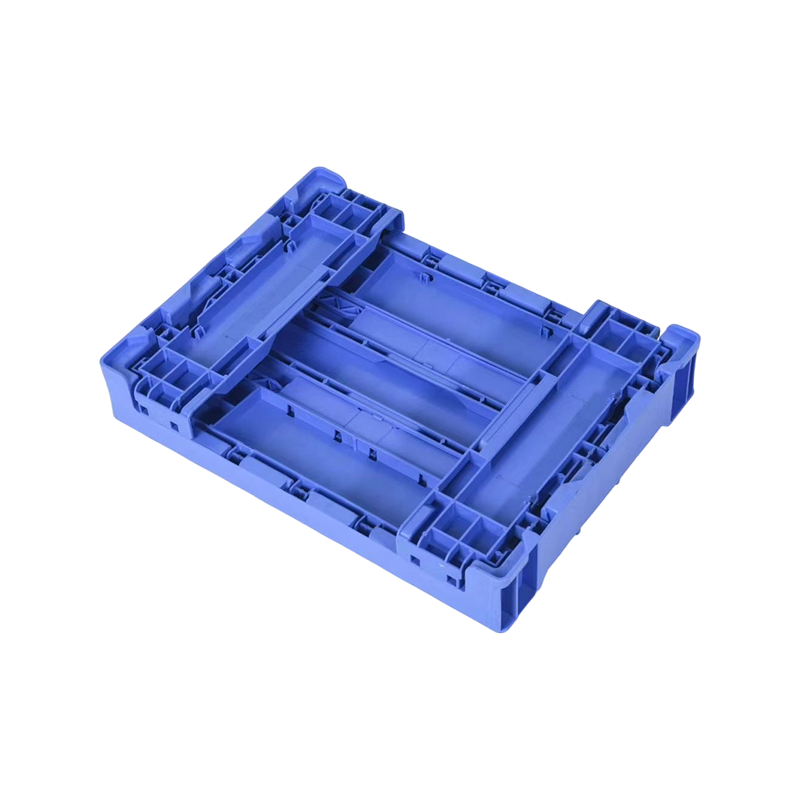
Check the color and feel of an actual sample wall. A crumbly or chalky surface indicates regrind content above an acceptable level; virgin co-polymer HDPE should feel smooth and flex without whitening at the hinges.
Freight and Space Math: What Collapsibility Actually Saves
Collapsibility pays for itself when the empty-return volume of a heavy duty collapsible crate drops to a third or less, because transport cost follows volume, not weight, in most consolidation lanes.
Take 1,000 empty 600 x 400 x 320 mm crates. In rigid form they occupy about 77 m3, which fills most of a 13.6 m dry van. Folded at a 3:1 ratio they shrink to around 26 m3, and a 4:1 fold design brings that down to about 19 m3. The chart below shows the effect on truck journeys per 1,000 empty crates.
Assumes a 600 x 400 x 320 mm crate, a 13.6 m dry van, and stackable return loads.
$29,000 Estimated yearly saving for 500 crates returning once per week over 400 km at $2.10 per truck km, when the fold ratio cuts effective empty-return cost by two-thirds. Warehouse floor area for folded crates typically drops by about 55 percent at the same time.
Procurement Checklist: What to Verify Before You Commit
The cheapest heavy duty collapsible crate is the one that still passes inspection after 5,000 handling cycles, so verify tooling and test data before comparing unit prices. At Xinhao Packaging's 8,000 m2 facility in Suzhou, load test certificates and deflection reports are part of the standard documentation package, and any serious supplier should be able to say the same.
- Request dimensional drawings for both assembled and folded states, including tolerance on the outer footprint.
- Ask for the load test certificate and the deflection limit at rated load, not just the raw static number.
- Confirm the hinge design and the target cycle count; metal pin hinges should carry a 10,000-cycle endurance claim.
- Check the crate footprint against your pallet and rack dimensions, including the folded stack height on a 1200 x 1000 pallet.
- Inspect an actual molded sample for wall thickness consistency, hinge stiffness, and the absence of regrind whiteness.
- Test one loaded pallet through your real forklift route, including a wash cycle, before approving the serial production tool.
Order samples from the same tool that will produce the serial run. Pre-production samples made by hand or from a prototype mold will not show the gate marks, weld lines, or cycle-time stress that appear in high-speed injection molding.
Frequently Asked Questions About Heavy Duty Collapsible Crates
A heavy duty collapsible crate holds 75 to 150 kg per unit in working service, survives 8,000 to 12,000 folding cycles with metal pin hinges, and stacks five high when the bottom crate is rated for the full column weight. The questions below cover the details procurement teams verify during supplier evaluation.
How much weight can a heavy duty collapsible crate hold?
A crate in the 600 x 400 mm footprint with double-wall rims is typically rated at 75 to 150 kg dynamic load per crate and 400 to 800 kg static load for the bottom crate in a stack. Confirm both numbers on the supplier's test certificate, because different definitions produce very different claims.
How many times can a folding crate be folded and unfolded?
With metal pin hinges and a reinforced rim, a heavy duty collapsible crate is designed for 8,000 to 12,000 folding cycles. Molded snap hinges typically last 3,000 to 5,000 cycles and are better suited to occasional warehouse use than daily returnable packaging.
Do collapsible crates work for automotive parts?
Yes, automotive, electronics, and machinery plants are the core application for collapsible crates, because parts flow one way and empty containers must come back cost-effectively. Manufacturers like Xinhao Packaging build dedicated industrial series such as the EUO, S, and F folding boxes with reinforced bases for exactly this return logistics pattern.
Can heavy duty folding crates be stacked when fully loaded?
Yes, but stack height depends on the crate's static rating, the uniformity of the base and rim contact areas, and the warehouse temperature. A five-high stack of 150 kg crates requires a bottom crate rated for at least 600 kg static load; verify the deflection limit at operating temperature, not at 20 C in the showroom.
Related Products
Contact Us
-
 zuokuan955@gmail.com
 -
 +86-13914090693
 -
 Building 5, No. 667 Hefeng Road, Xukou Town, Wuzhong District, Suzhou City, Jiangsu Province, China

- Quick Links
- Product Categories
- Portable Agricultural Bins
- Collapsible Plastic Crate
- View All Products
Copyright @Suzhou Xinhao Packaging Products Co., Ltd.
Industrial Plastic Container Manufacturer

Message Us Now !
WhatsApp

Mobile
