


 English
 Español
 中文

How Collapsible Pallet Boxes Cut Return Shipping Costs by 30-50% in Logistics
Every Friday afternoon, a 17.5-meter truck leaves the same electronics component plant with 75 empty rigid pallet boxes aboard. The driver is paid for the round trip, the fuel is paid for the round trip, and the trailer is billed by occupied cube, not by whether it carries parts or air. That empty return leg commonly represents 60-70 percent of the total round-trip freight bill, which is why collapsible pallet boxes have moved from a warehousing nicety to a cost-control standard.
Suzhou Xinhao Packaging Products Co., Ltd. (XINHAO PACK) has manufactured foldable plastic containers for industrial, automotive, and e-commerce logistics since 2012, exporting to more than 50 countries from an 8,000-square-meter plant in Suzhou, China. The company's most common customer request is not for stronger plastic; it is for a container that stops costing money when it comes back empty. That request reflects a measurable reality: the empty return leg is the largest avoidable cost in closed-loop packaging.
65-70% Height reduction when collapsed
3:1 More empty boxes per return truck
30-50% Net return-freight savings
8-10 yrs Typical PP container service life
01 / Where Return Freight Actually Drains Money
Empty backhauls are billed almost like loaded hauls, so any container that cannot shrink its empty footprint forces you to pay for trailer space you are not using. Freight carriers price distance and cube; a rigid pallet box at its full one-meter height consumes the same cube on the way back as it does on the way out.
Three cost pools make up the return-freight problem:
- Line-haul freight: the carrier charges by distance and occupied trailer space, and tall empty containers block consolidation.
- Dimensional-weight surcharges: volume-based tariffs penalize a 1.0-meter-high empty box exactly as much as a loaded one.
- Handling labor: dock workers spend the same time strapping and loading rigid boxes whether they hold product or nothing.
For low-density lanes, many plants avoid the return leg entirely with one-way corrugated packaging. That removes the empty truck but replaces it with a continuous purchase-and-disposal cost that usually exceeds the amortized cost of a plastic container after 15-20 trips on the same lane.
Rule of thumb: if a returnable container keeps its full height when empty, the return leg adds roughly 30-50 percent to the lane's total transport cost before packaging amortization. Cutting the empty height by two-thirds converts that premium into a manageable line item.
02 / How Collapsible Pallet Boxes Cut Return Shipping Costs
Collapsible pallet boxes cut return shipping costs by reducing the empty footprint of the container: a typical 1200 x 1000 x 1000 mm injection-molded polypropylene box folds down to about 1200 x 1000 x 300 mm. That is a 65-70 percent volume reduction, which in practice lets the same trailer carry roughly three times more empty units per return trip.
A collapsible pallet box is a reusable bulk container with a pallet base and hinged side walls that fold flat when empty. This is the single design feature that changes return-freight economics, because freight is priced on occupied cube.
Rigid pallet box
Empty return height: 1000 mm
Empty boxes per 90 m3 trailer: about 75
Return truckloads for 500 empties: 7
Dimensional-weight charge: full cube
Collapsible pallet box
Empty return height: 300 mm
Empty boxes per 90 m3 trailer: about 225
Return truckloads for 500 empties: 3
Dimensional-weight charge: one-third cube
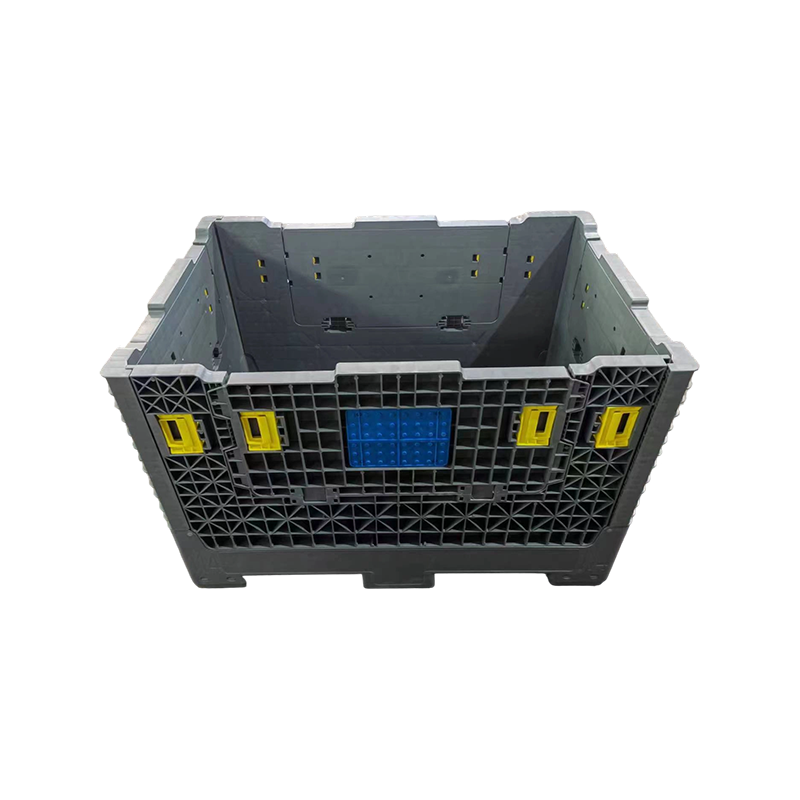
 Xinhao Pack 987 Series Collapsible Bulk Container with Fork PocketsThis collapsible PP bulk container reduces empty return volume to one-third cube, directly lowering dimensional-weight charges. Its impact-resistant walls and stable inter-stacking suit bulk parts like electronics and machinery.View Product →
Makers such as Xinhao Pack build this geometry into their 987 and 1000 series bulk containers, adding impact-resistant walls, fork pockets, and stable inter-stacking when collapsed. Side-opening variants cut picking time further because workers do not need to unstack the load to reach a part. The result is not a marginal improvement; it is a structural change in how much empty space the return lane has to pay for.
Achievable return-loading ratio 3:1 — the practical consolidation most fleets reach with collapsible pallet boxes
03 / The 30-50 Percent Reduction: What Collapsible Pallet Boxes Save in Practice
The 30-50 percent figure is the net result of three savings that compound: fewer return trucks, lower handling labor, and the elimination of one-way packaging purchases. No single discount produces the range; the combination does.
Consider a closed-loop lane running 10,000 pallet-box shipments per year over 500 km. The table below compares the annual logistics cost for one-way corrugated, rigid plastic pallet boxes, and injection-molded collapsible pallet boxes, using a $920 per-truck return rate and a 50 percent consolidation uplift on collapsed volume to reflect carrier minimums and mixed return cargo.
| Cost component | One-way corrugated | Rigid plastic | Collapsible plastic |
| Packaging purchase or amortization | $96,000 | $28,000 | $29,000 |
| Return freight | $0 | $122,000 | $61,000 |
| Handling, inspection, disposal | $5,000 | $18,000 | $9,000 |
| Total annual cost | $101,000 | $168,000 | $99,000 |
| Net saving vs rigid plastic | - | baseline | 41% |
Annual logistics cost per 10,000 pallet-box shipments (USD)
Assumes a 500 km return lane, 75 rigid or 225 collapsed boxes per truck, and a 50% consolidation uplift on collapsed volume for carrier minimums.
In this model the collapsible container cuts total annual logistics cost from $168,000 to $99,000, a 41 percent saving. The range shifts with fuel prices and labor rates, which is why operators report 30-50 percent across different lanes. E-commerce warehouse and third-party logistics operators running this model typically choose a heavy-duty container rated for repeated stacking cycles.
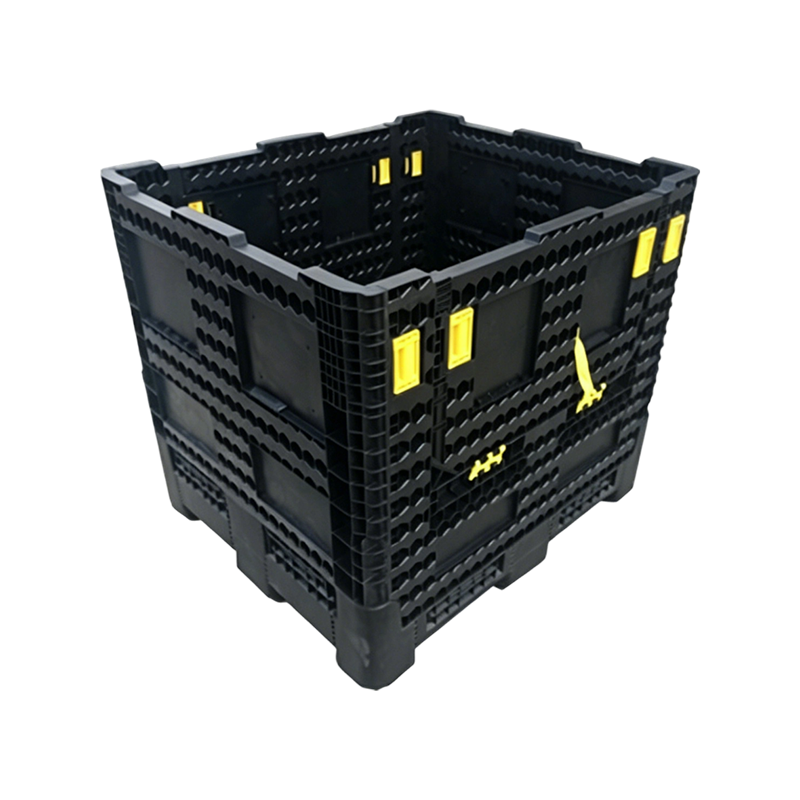
 Heavy-Duty Foldable Plastic Pallet Box for E-Commerce and AS/RSDesigned for e-commerce fulfillment and automated warehousing, this pallet box folds to 403mm height, supports 4–5 tons static load, and features a Chuan-base for 4-way forklift entry. It cuts empty return costs substantially.View Product →
04 / Selection Criteria: What Changes the Savings Outcome
The 30-50 percent savings are conditional: they materialize only when the collapsible pallet box matches your load weight, return frequency, and access requirements. The volume reduction is constant, but the freight saving depends on how fully you can consolidate the collapsed units in your actual trailer.
Five specifications determine whether your lane captures the full range:
- Collapse ratio: target a stowed height no higher than 35 percent of the assembled height, and measure it with the lid because lids change stacking.
- Static and dynamic load ratings: 500-800 kg dynamic and 4,000 kg+ static are the working band for industrial parts.
- Footprint: 1200 x 1000 or 1000 x 1200 mm must match your pallet rack, trailer floor, and automated handling equipment.
- Material grade: virgin PP with UV and impact stabilizers outlasts regrind material in repeated folding cycles.
- Hinge and door design: steel-pin or molded live hinges rated for 500+ cycles are the first components that fail in cheap boxes.
Check before you buy: request the collapse height with the lid attached, confirm the fork-entry clearance, and run 20 complete folding cycles on your own dock before standardizing a container across the network.
Xinhao Pack publishes a detailed specification and selection guide for foldable plastic pallet boxes covering dimensional load tables and procurement checkpoints for 2026 planning.
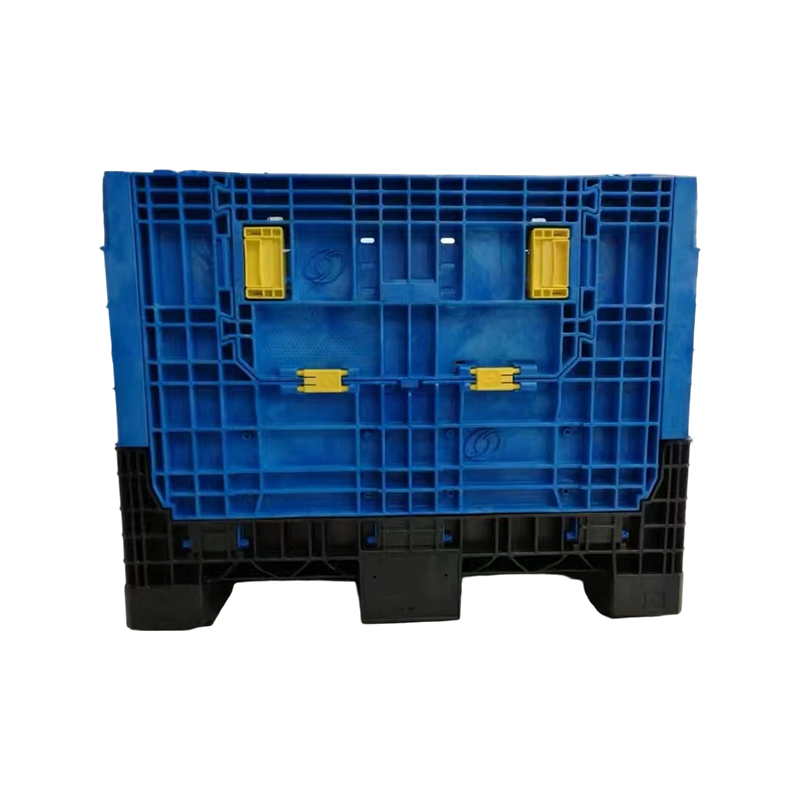
 Side-Opening Collapsible Pallet Container for Rapid LoadingIts side door enables loading and unloading without unstacking, saving labor time in automotive and retail distribution. The foldable design flattens for return shipments, reducing storage cost and improving picking efficiency.View Product →
05 / Implementation: Capturing the Savings on a Real Lane
Pilot the switch on one high-volume lane, measure the return cost before and after for 90 days, and then roll the standard across similar lanes. The container purchase is a capital decision; the freight saving is an operating result, and only measurement connects the two.
- Baseline the lane for 12 weeks: log outbound and return truck counts, freight invoices, and dock hours.
- Match the container standard to the return trailer: footprint, collapse height, and stacking pattern define the consolidation ratio.
- Renegotiate the return rate: with collapsed load height, shift the contract from per-pallet pricing to per-volume pricing.
- Train the dock team: folding, lid stacking, and edge protection add about 12 seconds per container but prevent most damage claims.
- Review the lane monthly: track cost per cubic meter on the return leg, and the 30-50 percent target should appear within two quarters.
Manufacturers that follow this sequence regularly report that the freight invoice drops in the first quarter, before packaging amortization reaches its steady state. The reason is structural: collapsed units change the truck count, and truck count is the largest driver of return-freight cost.
Frequently Asked Questions About Collapsible Pallet Boxes and Return Freight
How much can collapsible pallet boxes reduce return shipping costs?
Operators typically report net savings of 30-50 percent on empty-return lanes. The range comes from a roughly 3:1 reduction in return truckloads, lower handling labor, and the removal of one-way packaging purchases; dense, high-frequency lanes land at the top of the range.
What does the collapse ratio of a pallet box mean?
Collapse ratio compares assembled height to stowed height. A 1200 x 1000 x 1000 mm box that folds to 300 mm has a 3.3:1 ratio, so the same trailer carries roughly three times more empty units per return trip.
Do collapsible pallet boxes hold up in heavy industrial use?
Injection-molded polypropylene pallet boxes with dynamic load ratings of 500-800 kg and static stacking ratings above 4,000 kg handle automotive components and industrial parts across hundreds of cycles. Hinge and latch quality determines service life more than any other component, so ISO 9001-certified production and impact-resistant wall designs are the safest reference points.
Are collapsible pallet boxes cheaper than corrugated boxes?
In closed-loop lanes with more than 10-15 trips per year per box, the amortized plastic container becomes cheaper than continuously purchasing corrugated packaging. The collapsible design adds the return-freight saving on top, which is why high-volume lanes move to reusable plastic pallet boxes.
Related Products



Contact Us
-
 zuokuan955@gmail.com
-
 +86-13914090693
-
 Building 5, No. 667 Hefeng Road, Xukou Town, Wuzhong District, Suzhou City, Jiangsu Province, China

- Quick Links
- Product Categories
- Portable Agricultural Bins
- Collapsible Plastic Crate
- View All Products
Copyright @Suzhou Xinhao Packaging Products Co., Ltd.
Industrial Plastic Container Manufacturer

Message Us Now !
WhatsApp

Mobile
